Gold Projects in Victoria
Strategic exploration portfolio in one of the world's most prolific gold jurisdictions with proven infrastructure and exceptional discovery potential.
Victoria: Australia's Premier Gold Province
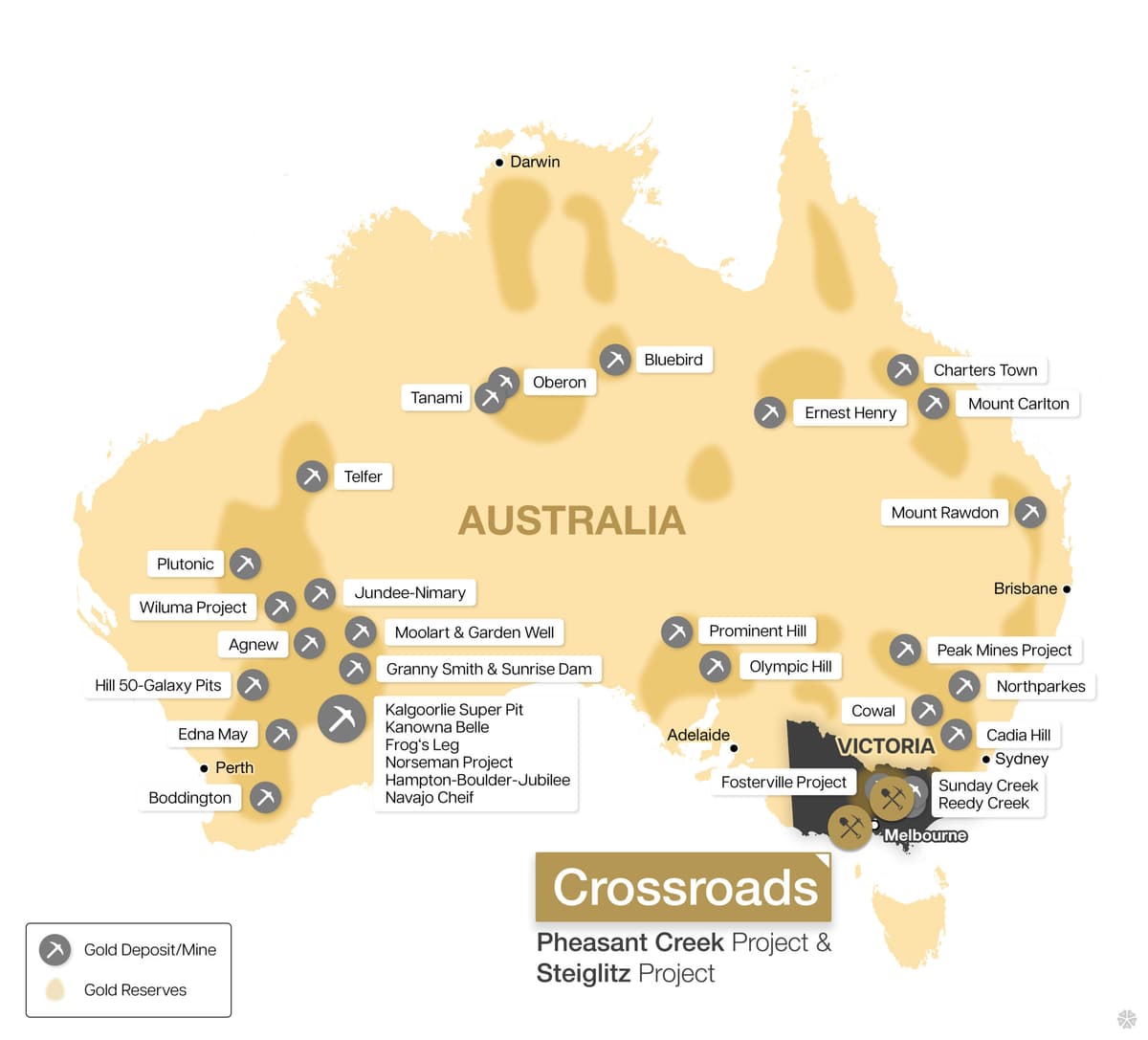
Victoria State has produced over 80 million ounces of gold since the 1850s gold rush, establishing it as one of the world's most endowed gold provinces.
Globally Recognized Tier 1 Jurisdiction
Australia is consistently ranked a top jurisdiction worldwide for investment and is home to world-class deposits including Fosterville (Agnico), Boddington, Cadia & Tanami (Newmont), Tropicana (AngloGold) and Kalgoorlie (Normandy/Homestake).
Robust Mining-Driven Economy
Mining contributes ~14% to Australia’s GDP and $400bn+ in annual exports. A deep pool of mining talent, service providers, drill contractors, geologists and assay labs enables short timelines from planning to execution.
Victoria: A Modern Gold Revival
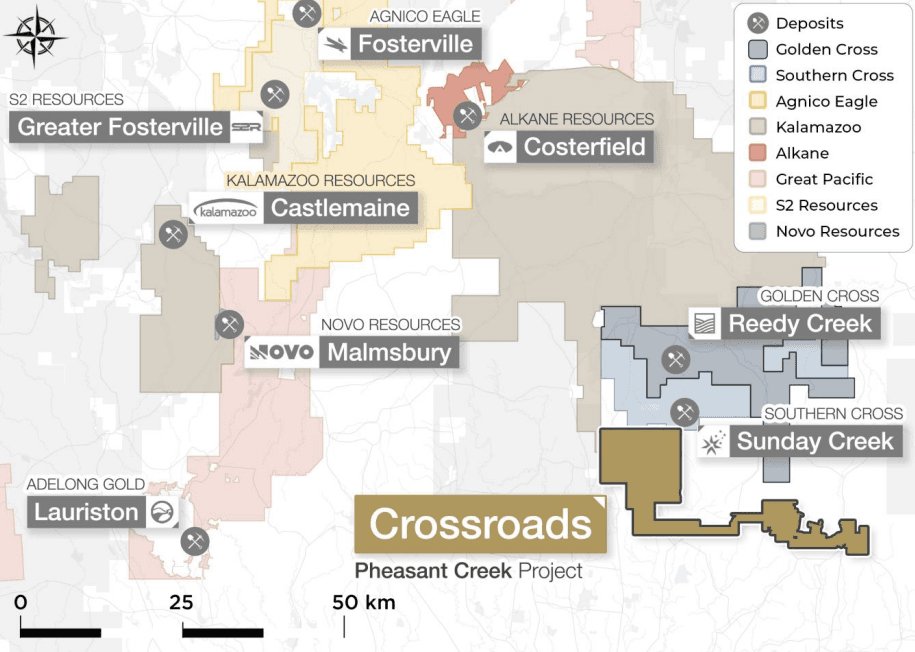
Victoria’s “Golden Triangle” is one of the highest-grade gold districts globally (Fosterville 30 g/t Au zones), with numerous underexplored structural corridors and new discoveries in the Bendigo–Ballarat zone (Southern Cross).
Victoria: Top Gold Producing State
Victoria has produced more gold than any other state, totaling 80M+ oz historically. Home to Agnico’s Fosterville Mine — one of the highest-grade, lowest-cost gold mines of the last decade — producing 4.6M oz to date (2024YE).
High Geological Prospectivity
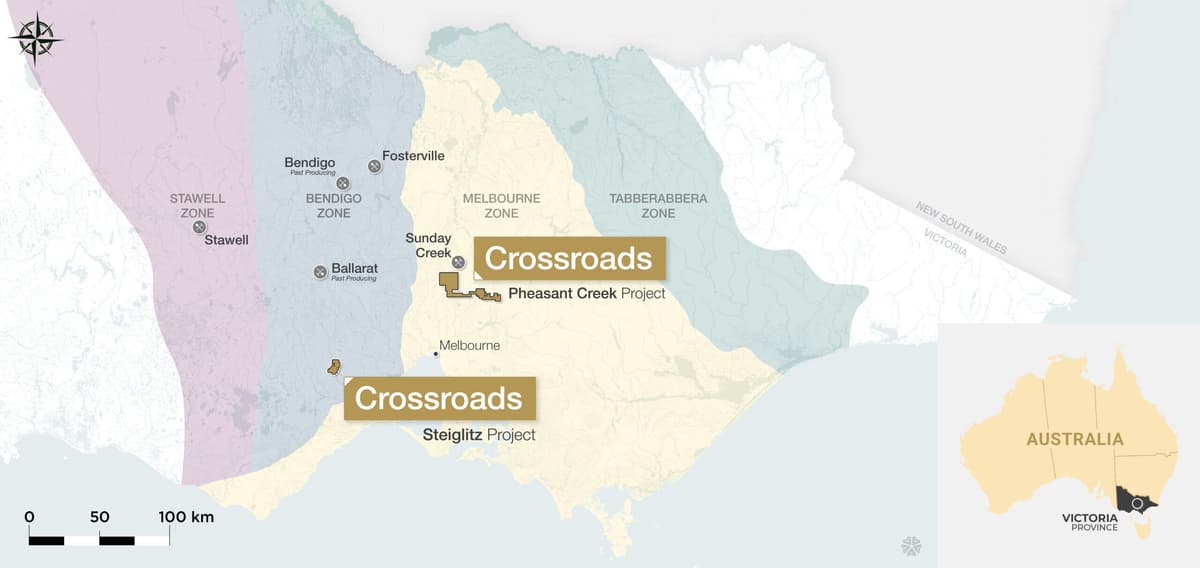
Geology dominated by the Bendigo and Melbourne Zones. Structural corridors with proven potential for 1M+ oz deposits, dominated by high-grade orogenic quartz vein systems.
Premier Infrastructure
Excellent access to Melbourne International Airport, highways, workforce, logistics and mining service hubs. Established land access frameworks and year-round exploration with a mild climate.
Supportive Mining Governance
Clear permitting paths for mineral titles and environmental baseline work. Favorable fiscal terms, with only a 2.75% state royalty on gold production.
Safe, Low-Risk Environment
Low political and sovereign risk with clear, stable rule of law, a transparent regulatory framework and supportive government policy for mining. High ESG standards, community engagement and Indigenous participation processes.
Victoria: A Robust Mining History Since 1851
Timeline of Gold Mining in Victoria
Fosterville revival in 2006 and Sunday Creek revival in 2022 have resurrected Victoria State
Gold first discovered
- •Beginning of Victorian Gold Rush
- •Population of Melbourne doubles in 10 years
Hard Rock Era
- •Bendigo, Ballarat start production
- •>60M oz produced during this period
- •Steiglitz produces 250k oz gold
- •Fosterville mined 1894–1903
The Decline
- •Shallow mining slowly exhausted
- •Limited modern exploration
- •Fosterville mined 1989 to 2003
Modern Revival
- •Fosterville restarts commercial production (open-pit sulphides), with UG mining starting in 2006
Fosterville Re-Rating
- •Swan Zone discovery with grades >30 g/t
- •Kirkland Lake valuation explodes
- •Fosterville produces >500,000 oz Au/year
Agnico acquires Fosterville
- •Agnico-Eagle completes acquisition of Kirkland Lake Gold as a merger-of-equals (pro-forma market cap of US$22.4bn)
Sunday Creek Gold Rush
- •Southern Cross pulls >100g/t Au intersections
- •Market cap balloons, stock up 10x
GPAC Divestments
- •GPAC divests Australian assets: Golden Cross acquires Reedy Creek
- •Adelong acquires Lauriston
- •SXGC reaches $3bn mkt. cap.
Emergence of Crossroads
- •Crossroads Gold lists on TSXV under symbol ‘CRG’
The Victoria Gold Rush — Key Assets
Pambula Gold Project
Historical High-Grade Gold Producer with Defined Mineralized Corridor and Drill-Ready Targets
Project Overview – The Pambula Gold Project is a 100%-owned gold exploration project located in southeastern New South Wales, Australia. Covering the entire historic Pambula Goldfield, the project hosts a minimum recorded historical production of approximately 45,000 ounces of gold and is situated within the highly prospective Eden–Comerong–Yalwal Rift Zone, a 320-kilometre-long mineralized corridor that hosts multiple hydrothermal gold systems. Historical drilling has intersected significant near-surface gold mineralization, including multiple high-grade intervals, while geological evidence points to a large-scale epithermal gold system that remains open along strike and at depth. With excellent infrastructure, a valid exploration licence (EL) through 2030, and several drill-ready targets already identified, Pambula represents one of Crossroads' highest-priority opportunities for near-term discovery.
Project Highlights
- 100%-owned project covering 81 km² in New South Wales, Australia
- Exploration Licence EL9833 granted and valid through November 2030
- Covers the entire historic Pambula Goldfield
- Historical production of approximately 45,200 ounces of gold from high-grade veins and breccia zones
- Located within the 320 km-long Eden–Comerong–Yalwal Rift Zone hosting multiple gold systems
- Defined 1.4 km mineralized corridor along three major north-south structures
- Evidence of a large-scale epithermal gold system with strong hydrothermal alteration
- Historical drill results include: 4 m @ 11.82 g/t Au, 5 m @ 7.20 g/t Au, 6 m @ 5.13 g/t Au, 2 m @ 33.05 g/t Au
- Mineralization remains open along strike and at depth
- Potential for both high-grade vein-style discoveries and broader bulk-tonnage mineralization
- Multiple drill-ready targets identified, including the Pilot Fissure Zone
- Excellent access, infrastructure and year-round operating conditions
Pheasant Creek
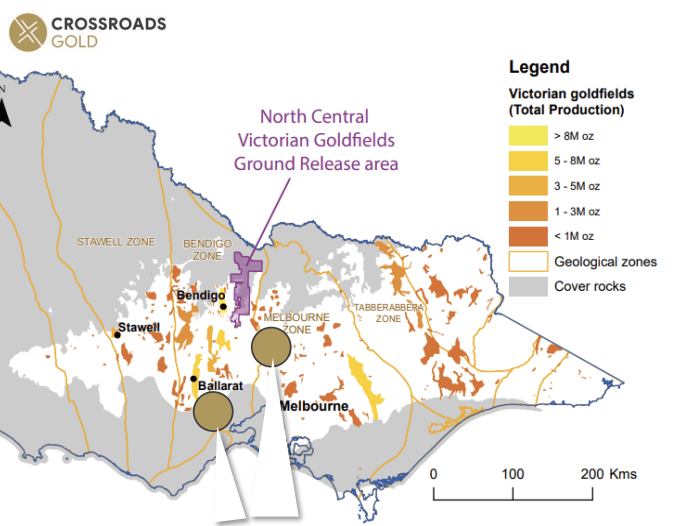
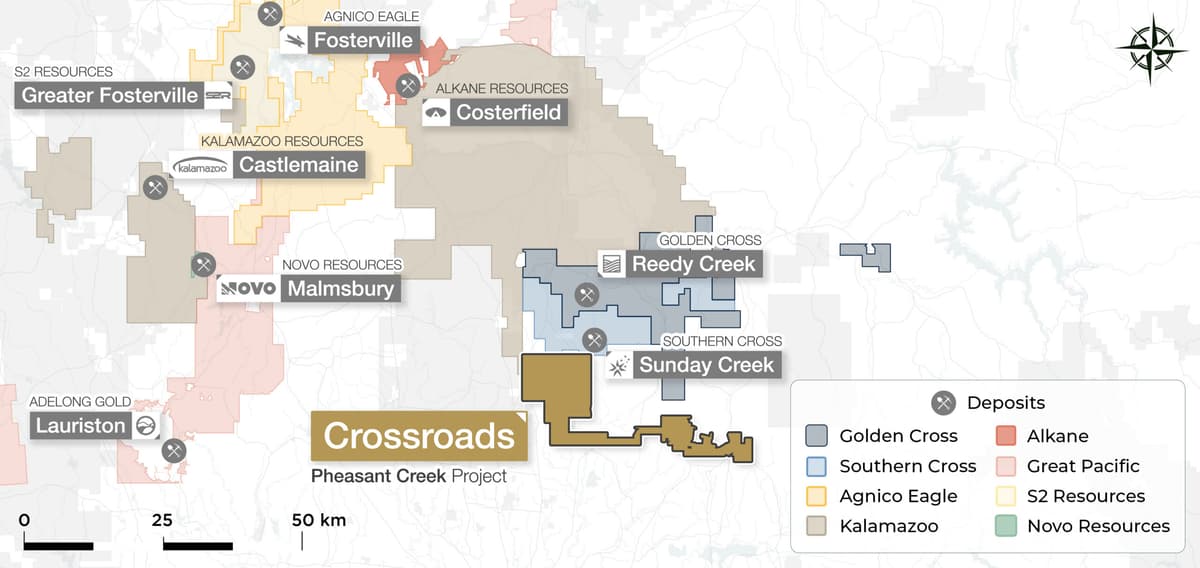
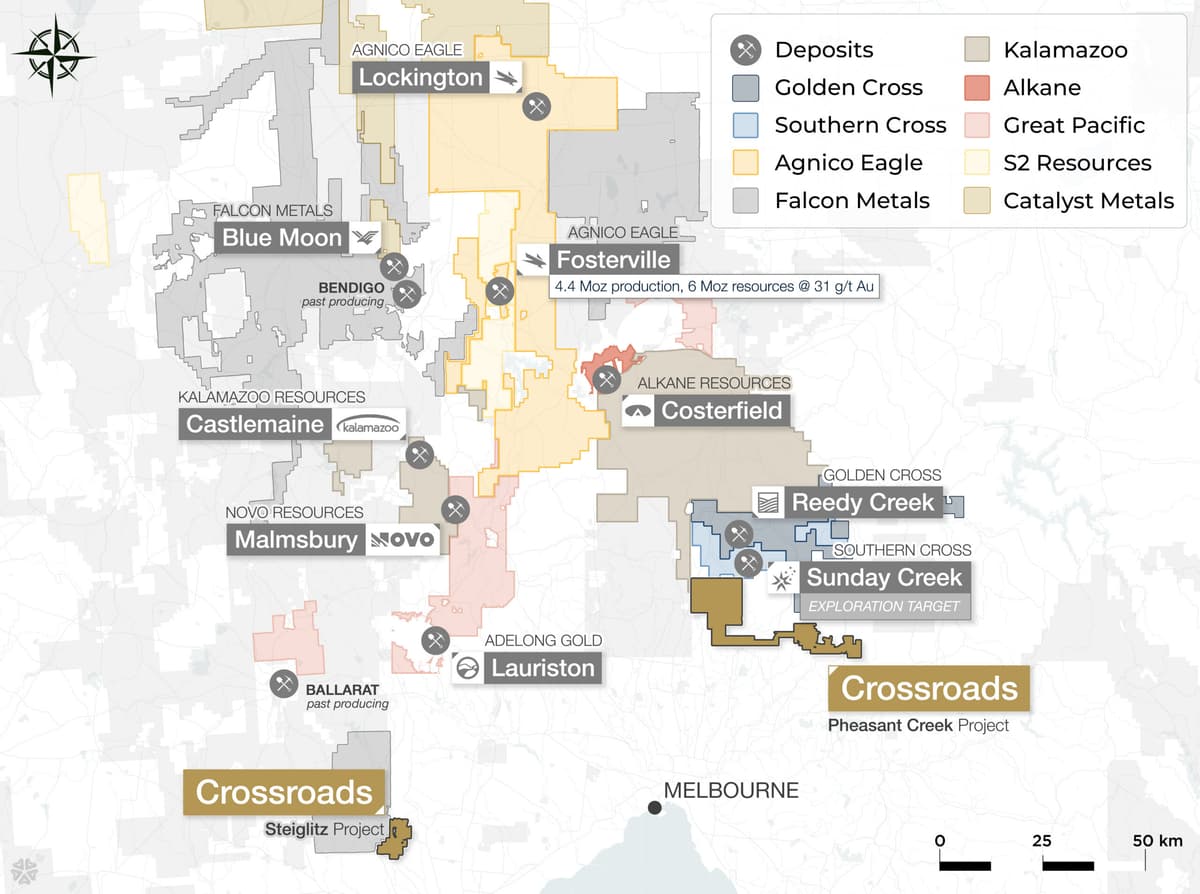
Strategic Position – Immediately adjacent (4 km) to Southern Cross Gold’s Sunday Creek discovery, one of the world’s best epizonal discoveries.
Geology – Epizonal, fault and dyke controlled gold-antimony mineralization analogous to Sunday Creek style system.
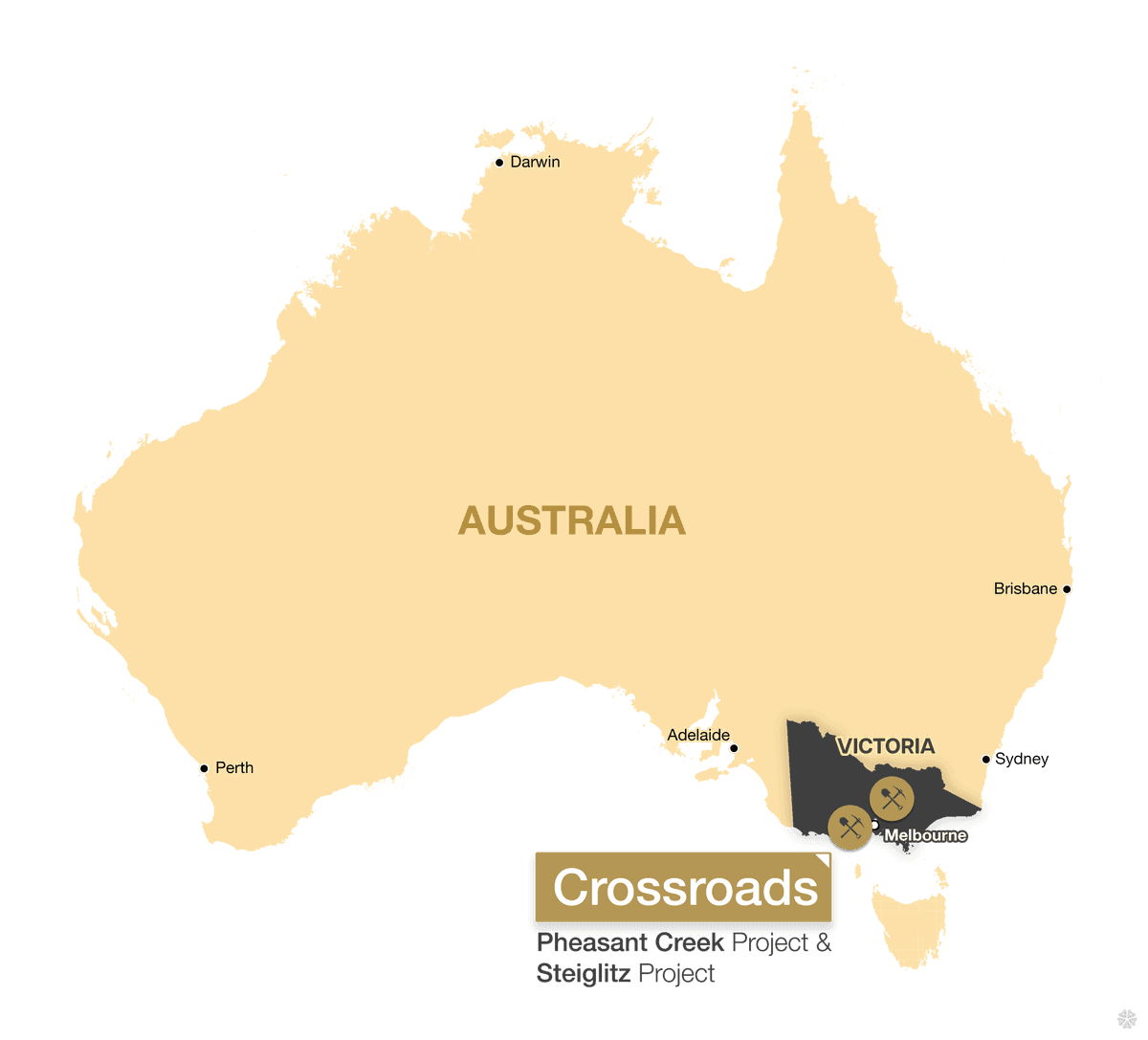
- Located 60km north of Melbourne, Australia
- Directly adjacent to Southern Cross’ Sunday Creek Project, only 4km from the deposit
- Adjacent to one of the world’s best epizonal discoveries
- Gold mineralization occurs as epizonal fault-controlled quartz veins
- 6km of under explored auriferous dykes mined in the 1890s
- Strong pathfinder anomalism (Au-As-Sb)
Steiglitz Gold Project
Historic Production – ~250,000 oz Au at recovered grades of ~38 g/t Au
Geological Setting – Historic production largely from parallel veins within a fault zone splay off the Hanover Fault. Gold-antimony vein system analogous to Fosterville gold deposits.
- One of the top historical producers in the Bendigo Gold Belt
- Limited modern drilling on the Hanover Fault only
- Located on the Fosterville – Selwyn Block margin trend
- High-grade precedent and strong structural controls remain unexplored
- Excellent access and infrastructure, 80km west of Melbourne
- Located within the prolific gold producing Bendigo Zone of the Lachlan Fold Belt
- One of the first hard rock Australian goldfields discovered in 1855
Unlocking a District-Scale Gold System
A Proven System, Never Fully Tested
The Steiglitz Goldfield was established in 1856 and quickly became a high-grade quartz reef mining district, producing rich specimen stone from multiple reefs. While early mining was largely shallow and fragmented, deeper operations in the 1890s demonstrated that gold mineralization persisted at depth, with workings extending beyond 750 feet.
Mining declined due to technical and capital limitations — not geological exhaustion. Historical records indicate the system remained open at depth and was never systematically explored using modern methods.
Crossroads is applying modern exploration techniques to a historically proven gold system with clear evidence of high-grade mineralization and depth continuity. Backed by an experienced team and strong capital markets support, the Company is advancing a pipeline of targets with the goal of unlocking a new gold discovery in one of Australia's most prospective belts.
Club Terrace Project
District-Scale Greenfields Gold Opportunity Along a 30 km Historic Gold Trend
The Club Terrace Project is a district-scale exploration project located in Victoria's East Gippsland region within the prolific Lachlan Fold Belt, one of Australia's most productive gold provinces. Covering 126 km² along a 34-kilometre-long structural corridor, the project encompasses a series of historic goldfields associated with major regional structures including the Bemm Fault and Club Terrace Fault. Despite a long history of alluvial and hard-rock gold mining dating back to the late 1800s, the area has seen remarkably little modern gold-focused exploration and no known modern gold drilling. Crossroads believes Club Terrace represents a rare greenfields discovery opportunity with the potential to identify a significant new gold system along a largely untested district-scale structural corridor.
Project Highlights
- Large-scale 126 km² land package in Victoria, Australia
- Covers a 34 km-long gold corridor and multiple historic goldfields
- Located within the Lachlan Fold Belt, which hosts more than 190 million ounces of historical gold production
- Situated along two major regional structures: the Bemm Fault and Club Terrace Fault
- Historical alluvial and hard-rock gold mining dating back to the late 1800s
- Historic production centres include Boulder, Club Terrace, Poddy Creek and Bemm River
- Virtually no modern gold-focused exploration completed across the project
- No known modern gold drilling completed within the project area
- Multiple historical gold occurrences distributed across a district-scale structural trend
- Strong geological similarities to other major gold deposits within the Lachlan Fold Belt
- Excellent potential for modern geochemistry, mapping and target generation
- High-priority greenfields discovery opportunity with potential for a major new gold system
Exceptional Discovery Potential in a Premier Gold District
Our strategic project portfolio positions Crossroads Gold for significant discoveries in one of the world's most prolific gold jurisdictions.